Did the Pre-Flood Patriarchs Actually Live to Nearly 1000 Years Old?
By Peter Salemi
Did the Old Testament Patriarchs actually lived as long as they did? Many feel that that this one of the proofs that the Bible is based on myth and not actually historical reality.
Others have tried to come up with alternative explanations on longevity of the Patriarchs. Here are a few:
As a purely mythical conception (Knobel, Bauer, Hartmann, Bohlen); which, however, may be safely rejected as an altogether inadequate hypothesis.
As due to an error in the traditional transmission of the genealogical registers, several names having fallen out, leaving their years to be reckoned to those that remained (Rosenmόller); but against this conjecture stands the orderly succession of father and son through ten generations.
As representing not the lifetimes of individuals, but dynastic epochs (vide supra); and
as signifying lesser spaces of time—e.g. three months (Hensler), or one month (Raske)—than solar years; but even Knobel admits that "no shorter year have the Hebrews ever had than the period of a year’s time." (Pulpit Commentary).
However, these explanations all have there faults. Like the high amount of years is due to a different method of calculating years. It has been argued that the ages were given in lunar months rather than solar years. The results of doing this are nonsensical. Adam would have fathered Seth at age eleven and Enoch would have only been five when he fathered Methuselah!
This source argues on some of these points, "Some have suggested that these 'years' are really only months, which would reduce 900 years to the normal life span of 80 years. However, this is implausible for two reasons. First, there is no precedent in the Hebrew OT for taking the word 'year' to mean 'month.' Second, since Mahalalel had children when he was only 65 (Gen. 5:15), and Cainan had children when he was 70 (Gen. 5:12), this would mean they were less than six years old-which is not biologically possible...Consequently, it seems best to take these as years (though they, were lunar years of 12x30 = 360 days)..."
"Others suggest that these names represent family lines or clans that went on for generations before they died our. However, this does not make sense for a number of reasons. First, some of these names (e.g., Adam, Seth, Enoch, Noah) are definitely individuals whose lives are narrated in the text (Gen. 1-9). Second, family lines do not 'beget' family lines by different names. Third, neither do family lines 'die,' as each of these individuals did (cf. 5:5, 8, 11, etc.). Fourth, the reference to having 'sons and daughters' (5:4) does not fit the clan theory." (When Critics Ask, pp.39-40, Geisler & Howe, emphasis added).
The historic view, that the early humans lived for long periods of time, can be maintained and is the only reasonable explanation. The natural way of reading the text in Genesis 5 is that each name mentioned was of an individual who fathered a son who himself, in turn, fathered a son.
There is nothing in Scripture that would have us believe that these ages were to be understood as anything but literal. In the New Testament, Luke treats the line of people from Adam to Noah in the same manner-as literal people. There is no convincing evidence that this genealogy, or any other genealogy recorded in Scripture, is doing anything but recording historical facts. Every biblical example where the age of an individual is recorded is written as history. This is true whether it be the age of a king of Judah at his accession to the throne, or the three instances where Luke records the age of the Lord Jesus (Luke 2:21, 42; 3:32).
But is there actual proof that these people lived as long as they did?
Our World and Theirs
First, we must stop looking at the pre-flood world as if it was in the same condition as ours! The Bible plainly says, “Whereby the world that then was, being overflowed with water, perished:” (2 Peter 3:6) The Pre-flood world is different than the world today! It is "perished"-gone what they had does NOT exist today!
The climate of the pre-flood world was vastly different than ours today; there is a major component that was removed, an antediluvian vapor canopy that enveloped the earth at the time of the pre-flood world. This vapor canopy would explain the different climate that we read in the book of Genesis. The Bible states that, "...God made the firmament, and divided the waters which were under the firmament from the waters which were above the firmament: and it was so." (Gen 1:7).
With this vapor canopy, the earth had a uniform climate. At that time the Bible describes that there was no rainfall (see Gen 2: 5,6). Little or no volcanic activity; universal warm climate, that is "indicated by all sedimentary strata" (The Genesis Flood, by Morris, p.250, emphasis added).
Zoologist Ariel A. Roth writes of the earth's past that, "Some evidence from the rocks and fossils indicates that the earth's past ecology may have been somewhat different. Examples are not difficult to find. The middle of the Phanerozoic portion of the column (Permian-Triassic) contains many red rocks-the oxygen-bearing 'red beds'...Temperature averages also appear to have been significantly warmer in the past. We can estimate such averages on the basis of warm- or cool-climate fossi1 organisms or oxygen isotope ratios that are temperature-dependent. Near the top of the geologic column fossils of forest trees appear in both present-day Arctic and Antarctic regions. Living forests do not exist there now. Close to the North Pole on Ellesmere Island we find fossil salamanders, snakes, lizards, And alligators, which indicate a much warmer climate in the past. In Antarctica, forests from the middle of the Phanerozoic, assumed to have been only 5-10 degrees of latitude from the South Pole when they grew, also appear to have grown in a warmer climate. They do not even show frost damage rings. In general, the evidence speaks of a warmer climate in the past than at present for most of the geologic column. Rough estimates suggest possibly 7-20°C warmer in the higher latitudes of both hemispheres. Such evidence indicates that the past was somewhat different from the present..." (Origins, pp.172, 173, emphasis added).
 |
 |
| A possible explanation for this amazing condition-the collapse of a vast antediluvian vapor canopy that surrounded and enveloped the pre-Flood World. It is believed that such a canopy would have produced a worldwide greenhouse effect. The climate would have been mild throughout the earth with insignificant seasonal variations. No rainfall or rainbows would have existed but rather a mist would rise from the earth that would water the whole face of the ground (Genesis 2:5-6). Violent storms, such as we experience throughout the world today, would have also been precluded by this canopy (Genesis 2:5-6). Such a canopy would also help to explain why palm leaves, fruit trees, tropical marine crustaceans, coral reefs, and vast amounts of sub-tropical plant life are buried under the polar regions. | |
To conclude, "Based upon extensive geological mapping of global sedimentary strata (megasequences) left behind after the Flood, we know that the pre-Flood world was radically different than the one we now live in. It is also obvious that, based on plant and animal life buried in the sedimentary strata of the Flood (i.e., fossils), the pre-Flood world was considerably more lush, diverse, and even allowed for many creatures to obtain extreme sizes. For example, some fossil dragonflies have been measured with wingspans over two feet. The method by which oxygen is diffused through an insect’s body in its tracheal breathing system places an upper limit on body size based on our current atmospheric oxygen levels. Thus, even secular scientists who deny the Biblical account of Earth’s history believe that oxygen levels had to be much higher in the ancient past." (Article; Hyperbaric Research and the Pre-Flood Atmosphere by, Jeffrey P. Tomkins, Ph.D. emphasis added).
With the collapse of the vapor canopy there was a radical change in the earth's climate and we have the conditions that we experience today.
With this understanding, could the pre-flood patriarchs live as long as they did?
What causes aging?
There are many factors that causes aging. Mostly it has to do with Environment, diet and genetics. This source writes, “aging is the generated by multiple causes damage to the structures and functions of the molecules, cells, organs, etc., of an organism. Such causes of aging include but are not limited to oxidative stress, glycation, telomere shortening, side reactions, mutations, aggregation of proteins, etc. In other words, it is the progressive damage to these structures and functions that we perceive and characterize as aging.” (article; Which Is the Most Significant Cause of Aging? By Stefan I. Liochev, emphasis added).
This "damage" is due to, "The cells in our bodies take quite a beating throughout our lifetimes. Environmental factors, such as ultraviolet rays, poor diet, and alcohol, as well as psychological factors including stress, are putting our cells at risk of significant damage.These factors cause damage to the DNA in our cells, predisposing us to cancer and other diseases." (Article; Telomeres: What causes biological aging? by Yella Hewings-Martin, Ph.D. emphasis added).
We have in our bodies what they call "Telomeres" These are, "Special structures...[that] keep a close eye on the damage that accumulates in our cells and signal when it is time for them to retire." (ibid) These, "Telomeres are stretches of DNA and proteins at the ends of our chromosomes. Each time a cell divides, these stretches naturally get shorter. Once telomere length reaches a particular cut-off point, the cell becomes senescent, meaning that it can no longer divide and will subsequently die....Scientists now know that many factors – including physical exercise, sleep, depression, and certain gene mutations – are associated with reduced telomere length, and, by extension, can lead to premature biological aging." (ibid) So due to environment, diet, sleep, physical activity, stress, and genes mutations, all these factors contribute to the telomere reduction length and eventually humans ageing, some quicker, some longer, and then death.
As shown above, the "world that then was" was vastly different than the one we experience today. The environmental factors alone show that the pre-flood world would have had a lot less damage to the body than it does today. With the vapor canopy in place ultra-violet rays were filter out, then after it collapsed, "...it surely is quite reasonable in view of what is known about the somatic and genetic effects of radiations to infer that, over the centuries since the Flood, the accumulation of these effects in man in particular has resulted in gradual deterioration and decreasing life-span.Especially marked must have been the effect in the centuries immediately after the Flood, in view of the precipitation of the earth's vapor blanket, which previously had filtered out practically all the environmental radiation which is now found in our troposphere. Little has been done as yet on the subject of the effect of these 'natural' radiations, but such information as is available clearly indicates that their effect is similar to that of artificial radiations. It is quite possible that most spontaneous mutations are ultimately attributable to the natural radiation in the environment; that is, the sun's ultra-violet rays, cosmic radiation products, radiocarbon, etc. The committee concurs that these spontaneous mutations are also harmful:" (The Genesis Flood, Morris, p.404, emphasis added).
Diet was also of course different, with the lush vegetation; and soil was not depleted as it is today giving them the optimal nutrients needed to sustain a healthy body.
Man is his original state was meant to live forever, “This is the book of the generations of Adam. In the day that God created man, in the likeness of God made he him;” (Gen 5:1).
Because of man's fall God says, “Thou shalt surely die” ‘dying, you shall die’ [lit. Hebrew]. Adam immediately died spiritually, and began to die physically on the very same day, just as we are all dying today; and, “And Adam lived an hundred and thirty years, and begat a son in his own likeness, after his image; and called his name Seth:" (Gen 5:3) Man became mortal (in Adam’s image) “in Adam all die” (Corinth 15:22). The process of aging began that day, the day of man's fall. So man was limited to under a 1000 years. Again, the environment was different, the processes of aging was slowed down at this time due to the fact that the old world is different from this one; and when the new world after the flood was established the processes sped up due to the different climate, the vapor canopy gone and the diet of all living species was different due to the less nutrients in the plants and therefore animals. Acceleration of ageing could conceivably be attributed to two major effects taking place —progressive changes in the genetic control of ageing and progressive changes in environmental conditions that would accelerate cell deterioration.
After the flood
After the old world was destroyed, we see drastic changes in the environment and man's longevity begins to decrease rapidly.

Just before the flood God announced that, "My spirit shall not always strive [margin. "abide"] with man, for that he also is flesh: yet his days shall be an hundred and twenty years." (Gen 6:3). God capped the age of man to 120 years. Now most human never live that long but there are rare exceptions but its not the rule.
But notice what God says, his "spirit" will not always "strive" [abide] with man. Why does he say this? Well, at that time the garden of Eden was still on earth and the cherubim's were guarding the tree of life! (Gen 3:24) The tree of life represents the spirit of God. This I believe also contributed to the long life spans of the pre-flood world. After the flood the tree of life in the garden was taken out, and therefore God capped the life span of man to 120 years. That is the general maximum age for man. But Psalms says, "The days of our years are threescore years and ten [70]; and if by reason of strength they be fourscore years [80], yet is their strength labour and sorrow; for it is soon cut off, and we fly away." (v.10). This, "was probably not intended as an absolute upper limit [the 120 years is-Genesis 6:3], but merely as an average for people who die of old age" (When Critics Ask, Geisler, p.41).
Now Noah, after the flood lived another "350 years" after the flood and died at 950 years (Gen 9:28-29). Why did Noah continue this long in the post-flood era? The Bible says, "Noah was a just man and perfect in his generations, and Noah walked with God." (Gen 6:9) Noah was perfect spiritually-he "walked with God" as Abraham did (Gen 17:1). But Noah was also physically, perfect. D. Guzik writes, "his description of Noah – unique to him – not only refers to the righteous life of Noah, but also to the fact he was yet uncorrupted by Satan’s attempt to sow something like a virus among the genetic pool of mankind [see Gen 6:1]. We could translate perfect in his generations as, 'Noah was pure in his genetic profile.'''(The Enduring Word Commentary, emphasis his and mine).
Noah still maintained the old world traits that he did NOT pass on to his children. It says Noah was "perfect in his generations" but it doesn't mean his children were! Notice, "We don’t know whether environmental factors perhaps only cause problems in the developmental phase of human life. However, one simple explanation of why Noah still lived for so long is that Noah’s genetic make-up was what gave him the potential to live so long. And that perhaps most, if not all, people before the Flood were programmed for much longer life spans than we are programmed for today. So what happened? Remember that the whole population shrank to just a handful. There are well known ways in which forms of genes (known as alleles), which could include any coding for longer life spans, can be eliminated from a population that has gone through such a ‘bottleneck’—down to eight people"...There is a well-known and simple phenomenon called ‘genetic drift’, through which varying forms (alleles) of genes (stretches of DNA coding for various characteristics) can become lost in small populations. Genes come in pairs; you inherit one from your mother and one from your father. In the example shown above diagrammatically, the ‘G’ form of the gene is present in father and not in mother. Each of their children only has a 50–50 chance of inheriting the ‘G’ version of that particular gene, as shown. Therefore the possibility that none of the offspring will inherit this gene is not at all a remote one. (If they only have three children, the chance is 1 in 8). In a situation in which the entire human race was reduced down to Noah, his three sons and their wives, it is entirely feasible that some forms of the genes present in Noah were not passed on. Since it now appears that much of aging is under genetic control, loss of some of the genes for longevity may be the reason for the drop post-Flood." (Article; Living for 900 years by Carl Weiland, emphasis added).
Archaeological Evidence
Is there any ancient human fossils that confirm the longevity of the pre-flood world? Sir J. William Dawson in examining some of the oldest human fossils says that One of the chief characteristics of all these remains is the extreme longevity characteristic of the skeletons. He writes, "Another point which strikes us in reading the descriptions of these skeletons is the indication which they seem to present of an extreme longevity. The massive proportions of the body, the great development of the muscular processes, the extreme wearing of the teeth among a people who pre dominantly lived on flesh and not on grain, the obliteration of the sutures of the skull, along with indications of slow ossification of the ends of the long bones, point in this direction , and seem to indicate a slow maturity and great length of life in this most primitive race" (chapter 5, "The Meeting Place of Geology and History" by Sir J. William Dawson, pp. 62-63, emphasis added.)-just as Genesis declares! Such characteristics of the skeletal frame are completely absent from modern degenerate man. That these ancient men did attain great age is demonstrated by the fact that their remains are usually found with fragmentary skeletons of youths and babies not exhibiting those characteristics. These genuinely scientific findings substantiate the truth of the bible that men in ancient times, unlike today, experienced centuries of physical life.
|
Age drop off through the Centuries |
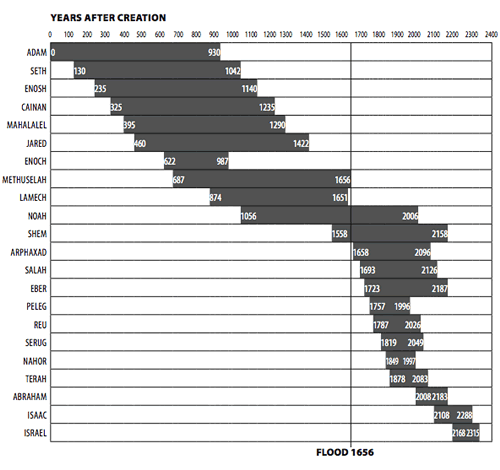
Why the life spans overlapped? I believe there is another purpose for the long life spans. If you notice in the graph below, there is an overlapping of certain patriarchs one with the other.
It is hard to imagine that Abraham could have spoken to Shem (Noah’s son) or even Noah himself? Who surely talked to Methuselah, who in turn could have spoken to Adam, the first man, directly. However it is a real possibility. We see in Genesis 6:2, the "sons of God" meaning the godly line of Seth, in a distinct group separate from the "daughter of men" meaning the line of Cain. There were obviously in close vicinity one with another. What was the purpose to this? Speaking of Noah Lamech said, "This same shall comfort US concerning our work and toil of our hands, because of the ground which the Lord hath cursed" (Genesis 5:29). Notice their "work" AND the "toil of our hands." Its NOT their work COMMA, the toil of their hands. It is talking about two different things. What was their work? Preserving and passing on the word of God and the truth of God. In my article Who wrote the book of Genesis, I show that the art of writing has been around since the beginning of mankind. God's word has always been written by the people that were actually there to witness the events and heard God speak directly to them. (examples, Exodus 17:14; 1 Sam 10:25; Isa 30:8; Jer 30:2; Dan 12:4; Rev 22:7, 9, 10, 18, 19). In Gen 5:1 what do we see? "This is the book of the generations of Adam. In the day that God created man, in the likeness of God made he him;" This book was preserved, and kept with the ten Patriarchs. The story of creation, the story of Adam and Eve, Cain and Abel etc... was all an eyewitness account written by Adam and was preserved; and it was their "work" of preserving the knowledge of God passed on to Noah. Noah took these clay tablets into the Ark with him, and then preserved and kept it until Abraham! Noah lived for 950 years "I.e. to the fifty-eighth year of the life of Abram, and was thus in all probability a witness of the building of the tower of Babel, and of the consequent dispersion of mankind. And all the days of Noah were nine hundred and fifty years: and he died. Tuch, Bleek, and Colenso connect these verses with Gen 9:17, as the proper continuation of the Elohist’s work." (Pulpit Commentary, emphasis added). Noah recorded all the events in Genesis 10 and 11 including the dispersion of mankind throughout the world. Then, when Abraham was called by God in, "Ur of the Chaldees," (Gen 11:31; 15:7) it was there that Noah and Abraham conversed and Noah passed on to Abraham the clay tablets-the eyewitness accounts given to him by the 10 Patriarchs, and his record of the flood, the tower of Babel, and the dispersion of mankind. If not Noah, then Shem, who was appointed to be the chosen seed to preserve God's word (see Gen 9:26), "For Adam lived unto the time of Noah’s father. And so could have passed on the story of creation, the garden and all to Noah’s father. Noah himself passing it on to Shem, his son, who lived to the time of Abraham and related the whole thing to Abraham. So you don’t have the story too far removed from Abraham." (Through the Bible Commentary by Chuck Smith, emphasis added).
|
 |
Traditions of Great Longevity in other Cultures
Critics are quick to jump to the conclusion that because we see other cultures with the same tradition of long life spans in their legends and myths, then the same can be said about the Bible? However the evidence shows the opposite is true.
First, "According to the Weld-Blundell Prism, eight antediluvian kings reigned over the lower Mesopotamian cities of Eridu, Badtibira, Larak, Sippar and Shuruppak; and the period of their combined rule totaled 241,200 years (the shortest reign being 18,600 years, the longest 43,200). Berossus, a Babylonian priest (3rd century B.C.) lists ten names in all (instead of eight) and further exaggerates the length of their reigns. Other nations too have traditions of primeval longevity.
 |
From Halley's Bible Handbook p.71 |
"Attempts to correlate Berossus' ten kings with the ten patriarchs have failed.” (Merrill Unger, The New Unger's Bible Handbook, p. 47, emphasis added).
The very fact that there is a universal tradition of the longevity of the patriarchs in the pre-flood world proves that it's a fact, not the opposite, "It seems that the ancients, in speaking of their Prehistoric times, fell into the same temptations that our moderns do, of exaggerating to vast dimensions the chronology of their primeval world. Besides the Babylonians: Persians, Egyptians, Hindus, Greeks, and others had traditions of the great longevity of earth's earliest inhabitants. Where could such traditions come from, except from the fact that the first men did actually live long?" (Halley's Bible Handbook, p.72).
Unger also concludes, "the names as presented by the Sumarian King List and Berossus evidently represent a corrupted tradition of the historical facts as preserved in Genesis 5" (ibid, p.47).
Since all peoples of earth are descended from Noah or his sons, information could have been passed to them by word-of-mouth. Such recollections support the idea that information passed from Noah to his descendants who then spread across the globe; As they got farther and farther from the center of knowledge obviously these stories got corrupted and exaggerated. The older the stories are, the more they resemble the book of Genesis NOT the other way around so the original accurate histories are in the Bible. "In the ancient Near East, the rule is that simple accounts or traditions may give rise (by accretion and embellishment) to elaborated legends, BUT NOT VICE VERSA. In the ancient Orient, legends WERE NOT SIMPLIFIED or turned into pseudo-history (historicized) as have been assumed for early Genesis...The recent discoveries of Creation accounts at Elba confirm this. The library of more than 17, 000 clay tablets pre-dates the Babylonian account by about 600 years. The creation tablet is STRIKINGLY CLOSE TO GENESIS...This shows that the BIBLE CONTAINS THE ANCIENT, LESS EMBELLISHED VERSION OF THE STORY and transmits the facts without the corruption of the mythological rendering" (When Skeptics Ask, p.182, emphasis mine).
Another author concludes, “It is highly unlikely that the biblical account was derived from the Sumerian in view of the differences of the two accounts, and the obvious superiority of the Genesis record both in numerical precision, realism, completion, and moral and spiritual qualities. It is more likely that the Sumerian King List was composed using Genesis for numerical information. Obviously, the Book of Genesis would only be used if the person writing the list believed it to be a true historical account containing accurate information." (Raul Lopez, “The Antediluvian Patriarchs and the Sumerian King List,” CEN Technical Journal 12, no. 3 (1998): p. 347–357.).
Conclusion
The Bible proves itself to be an accurate account of man's history. With all the environmental, genetic, and other changes that this earth has experienced in its history, it is truly plausible that man lived as long as the Bible says he did during the pre-flood era. History, archaeology, the embellished pagan legends and science demonstrates the fact that man did live that long. So The real question then becomes not, "How could they have possibly live for so long?", but rather, "Why don’t we live that long any more?"